
Wheel alignment in Winthrop Harbor for cars to 4500 and 5500 series trucks
Pfeiffer Auto Clinic performs wheel alignments in Winthrop Harbor, Illinois, on a Hunter Hawkeye Elite alignment system on a Hunter heavy-duty, long-deck four-post alignment rack rated at 18,000 lb. That top-of-the-line setup handles everything from small cars to 4500 and 5500 series trucks, including long-wheelbase dually pickups, cargo vans, and box trucks. Have the alignment checked if the vehicle pulls to one side, the steering wheel sits off center, the tires wear unevenly, or after new tires, a pothole hit, or suspension and steering repairs. Call (847) 746-8291.
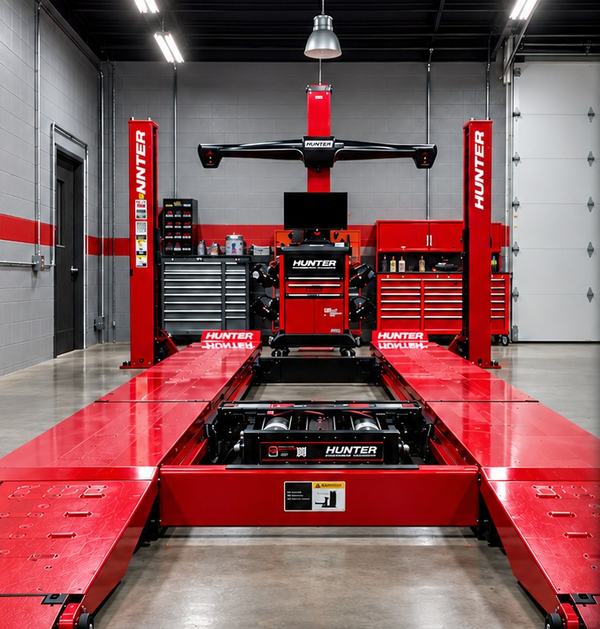
The alignment equipment
- Hunter Hawkeye Elite aligner with four high-definition cameras that read the wheel targets in real time
- Hunter heavy-duty four-post rack, long deck, rated at 18,000 lb, with room for long-wheelbase dually pickups
- Built-in air jacks that lift the wheels off the rack for inspection and adjustment
- Factory alignment specifications from Hunter's WinAlign software, with step-by-step adjustment procedures
- Steering angle sensor reset through the OBD-II port on vehicles that need it after an alignment
- Live ride height readings for lifted, lowered, and loaded vehicles
From small cars to 4500 and 5500 series trucks
The long, heavy-duty rack at Pfeiffer takes compact cars and crossovers, half-ton and heavy-duty pickups, dually pickups, Ram ProMaster and other full-size vans, and 4500 and 5500 series chassis cab trucks, including the delivery trucks, box trucks, and specialty work trucks that local businesses run every day.
What an alignment adjusts
- Toe: whether the tires point straight ahead or slightly in or out. Toe that is off wears tires fast.
- Camber: the inward or outward tilt of the tire. Off camber wears one edge of the tread.
- Caster: the angle of the steering axis, which affects straight-line stability and steering return.
- Thrust angle: whether the rear axle points the same direction as the front, so the vehicle tracks straight.
Signs you need an alignment
- The vehicle pulls or drifts to one side on a straight, level road
- The steering wheel is off center when driving straight
- Uneven or fast tire wear, such as one worn edge
- Loose or wandering steering on the highway
- You just installed new tires, or hit a pothole or curb hard
- You had ball joints, tie rod ends, struts, or other steering and suspension parts replaced
Potholes and lakefront winters
Freeze and thaw cycles near Lake Michigan open potholes every spring on Sheridan Road and the county roads around it. One hard hit can knock the alignment out. An alignment check after pothole season protects a set of tires, which costs far more than the alignment.
Alignment starts with an inspection
Worn parts make an alignment impossible to hold. Before we adjust anything, we check the tires, ball joints, tie rod ends, control arm bushings, and wheel bearings. If something is worn, we show you before any work begins, so the alignment stays where we set it.
Frequently asked questions
How often should I get a wheel alignment?
Have it checked once a year, whenever you install new tires, after a hard pothole or curb hit, and after steering or suspension repairs. Check your owner's manual for your vehicle's recommendation.
Can you align a 4500 or 5500 series truck?
Yes. Pfeiffer's heavy-duty, long-deck Hunter Hawkeye rack is rated at 18,000 lb and handles everything from small cars up to 4500 and 5500 series trucks, including dually pickups, vans, and box trucks.
What alignment machine does Pfeiffer use?
A Hunter Hawkeye Elite alignment system with four high-definition cameras, on a Hunter heavy-duty, long-deck four-post rack rated at 18,000 lb.
Do I need an alignment after new tires?
It is a good idea. An alignment protects the new tires from uneven wear from day one.
Will an alignment fix a vibration?
Vibration at highway speed is usually wheel balance, a bent wheel, or a tire problem. An alignment fixes pulling, an off-center steering wheel, and uneven wear.